The latest quarterly timber stumpage price data available from the Penn State Extension Pennsylvania Timber Market Report covers the Fourth Quarter of 2025 (October to December). We focus on six hardwood species that have the largest commercial impact on Pennsylvania’s solid wood products industry to help landowners make informed decisions. Please keep in mind that some quarters contain few or no survey responses; prices may appear more volatile due to small sample sizes.
Pennsylvania Hardwood Timber Prices Snapshot (Q4 2025)
Based on the most recent data from the Penn State Extension survey of timber market participants across Pennsylvania, the following trends were observed entering the Fourth Quarter of 2025:
- Regional price variation remains a prominent feature of the timber market in Pennsylvania.
- Red oak and white oak saw strong year-over-year increases, indicating robust demand, particularly in construction and furniture markets.
- Black cherry continues to show price growth, but with fluctuations in quarterly pricing.
- Hard maple and yellow poplar prices exhibited volatility, influenced by regional demand and market conditions.
- Soft maple remains one of the stronger performers, consistently pricing in ranges with hard maple when supported by clean color yield.
We summarize regional and species-specific trends in more detail below.
Red Oak
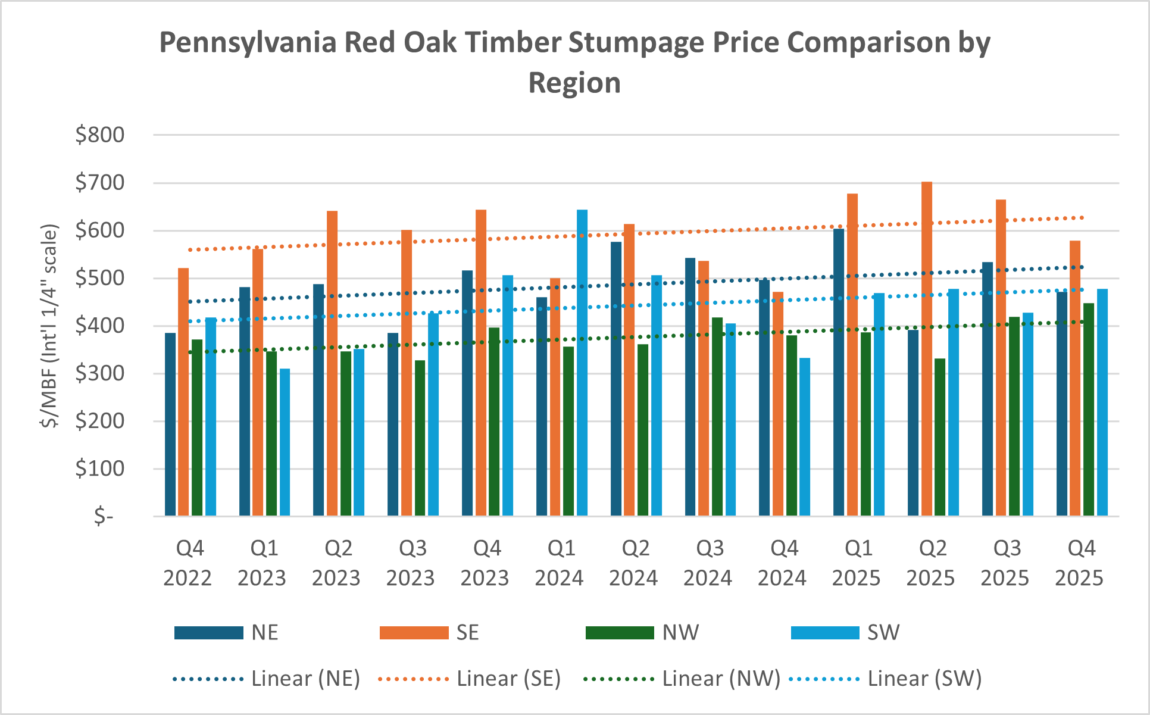
- Year-over-Year: Red oak prices saw significant year-over-year price increases in most regions, ranging from 23% to 44%. Availability is also causing upward pressure going into the spring.
- Market Implications: These changes point to a growing market for red oak, especially in areas with strong demand for construction and furniture-grade timber. Flooring-grade demand remains difficult and price sensitive.
White Oak
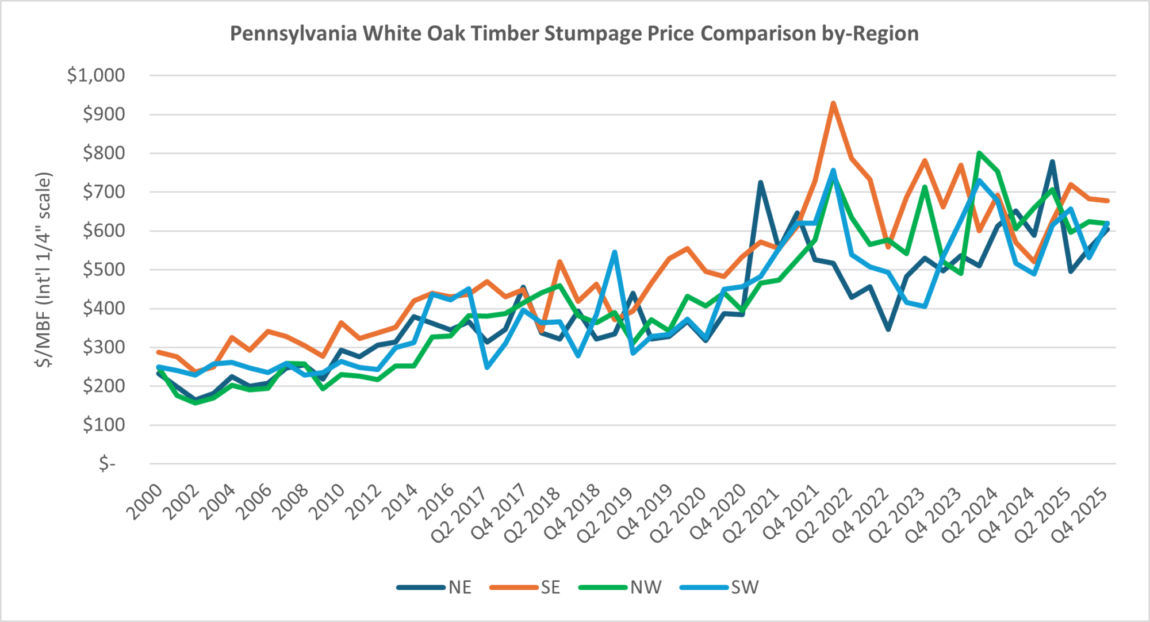
- Year-over-Year: All regions except the northwest (-6%), reported year-over-year price increases but have come down from the 2022 all-time high.
- Market Implications: White oak remains one of Pennsylvania's most highly valued hardwoods, maintaining strong demand across multiple markets. Stave log supply for bourbon barrel making reports heavy supply and the demand outlook for bourbon barrels is predicted to decline. This could indicate that the market is coming off an all-time high and likely will level out or continue to decline.
Black Cherry
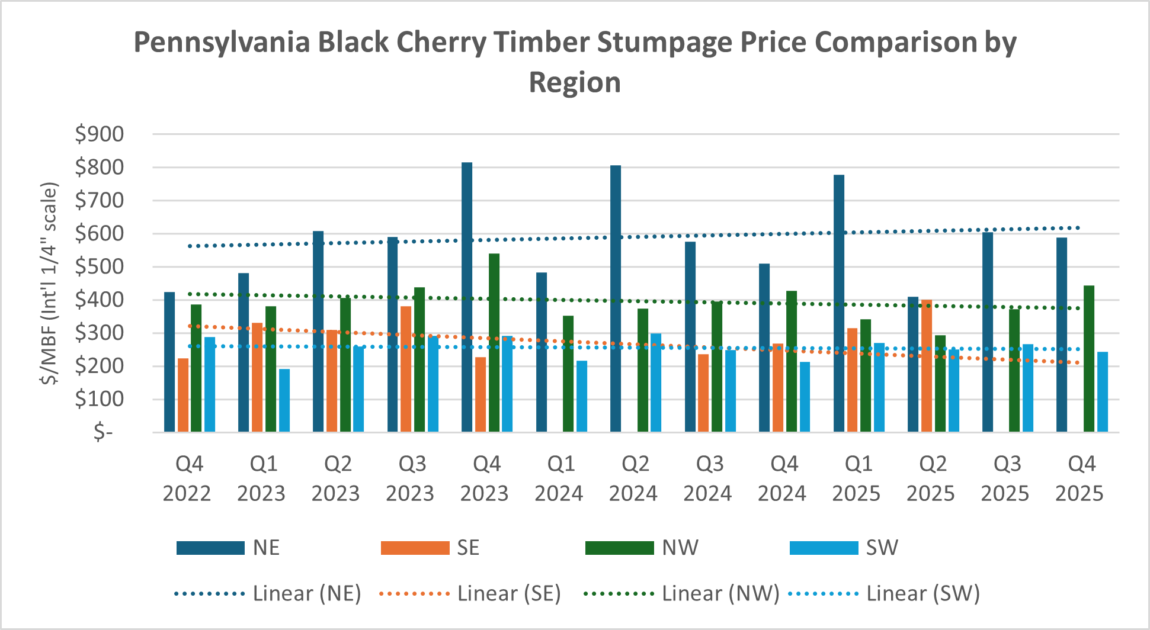
- Year-over-Year: All reporting regions experienced year-over-year price increases, ranging from 4% to 15%.
- Market Implications: Demand for higher-grade black cherry continues to drive price increases, with a notable boost in some regions. Prices are at an 18-month high in most regions with the future and outlook mixed.
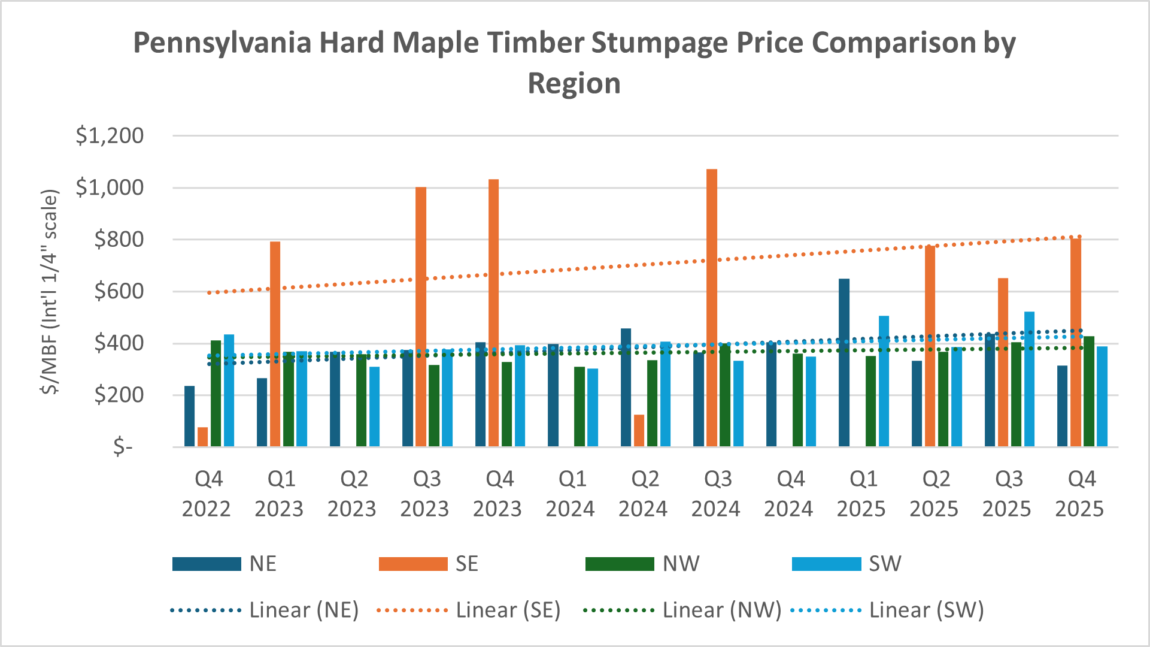
Hard Maple
- Year-over-Year: Western counties reported price increases of 11% to 19%, while the northeast experienced a sharp -22% decline.
- Market Implications: The price volatility of hard maple highlights the influence of regional demand and local market conditions, with some areas experiencing sharp price drops. Higher grade timber is selling better than common due to the ability to utilize soft maple as an alternative.
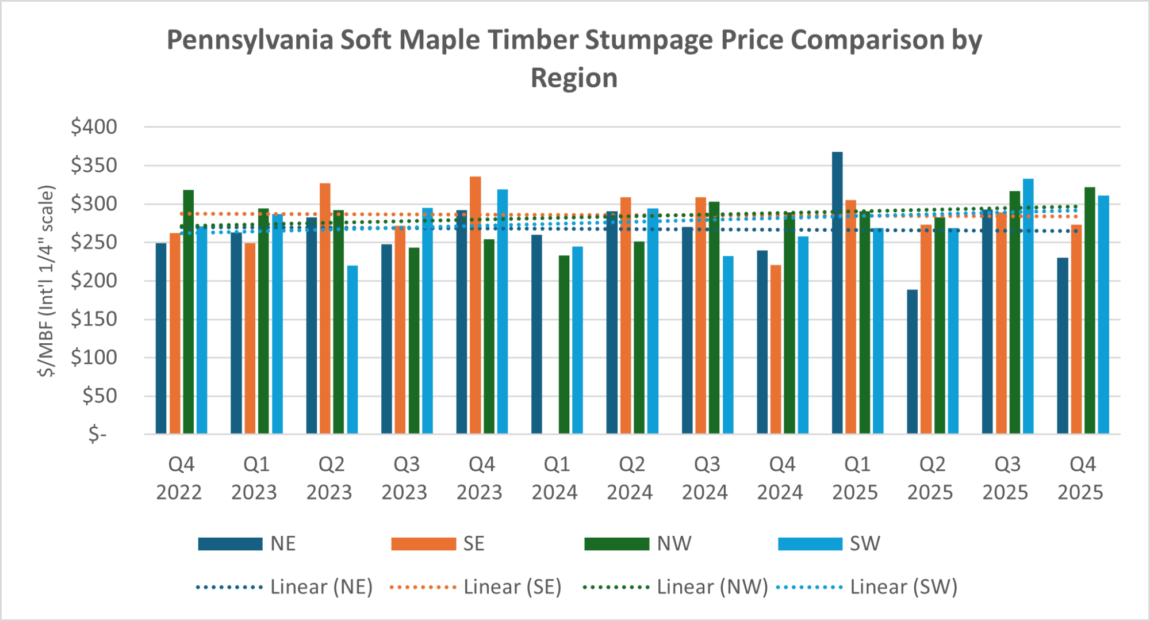
Soft Maple
- Year-over-Year: The northwest, southwest, and southeast all saw increases of 11% to 24%, while the northeast reported a small decline of -4%.
- Market Implications: Soft maple remains a consistent player in timber sales due to its broad market uses and availability.
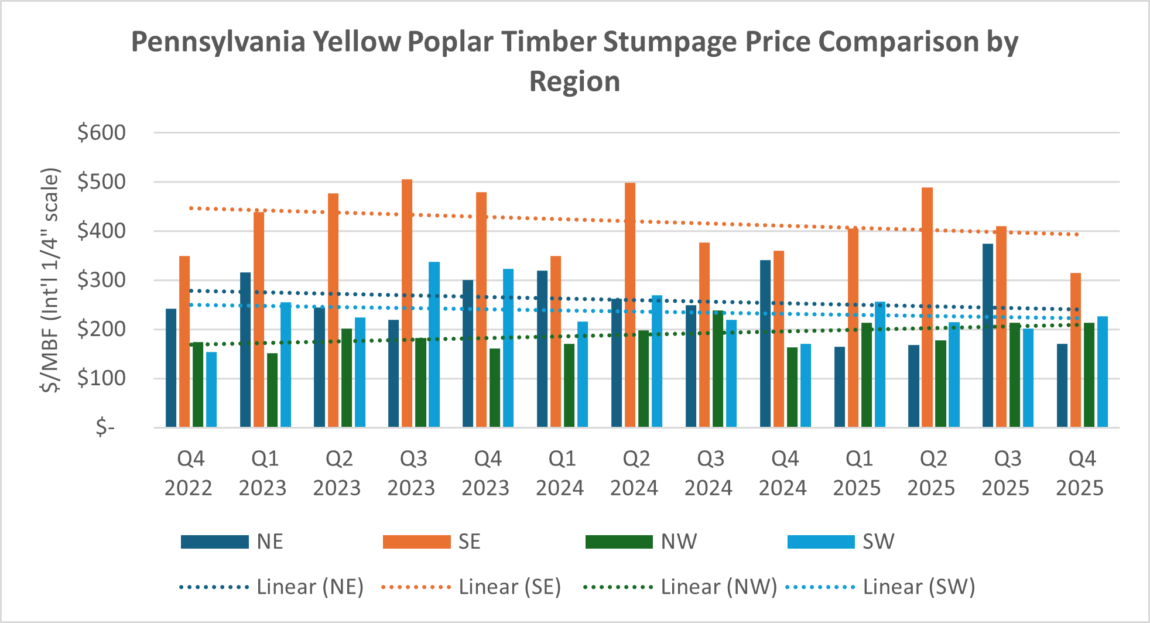
Yellow Poplar
- Year-over-Year: Eastern counties saw declines from -13% to -50%, while western counties reported year-over-year increases of 30% to 33%.
- Market Implications: Yellow poplar continues to face variable pricing depending on regional supply and demand, with a more stable market in the west compared to the east. Sample size of the Penn State data may also be a factor.
What Is My Timber Worth in Pennsylvania?
Many landowners reviewing statewide timber price reports eventually ask the same question: What is the timber on my property worth?
While the Penn State Extension Timber Market Report provides helpful regional averages for hardwood stumpage prices across Pennsylvania, the value of timber on an individual property can vary significantly depending on factors such as:
- Tree species and timber quality
- Timber volume and stand density
- Logging accessibility and terrain
- Distance to nearby sawmills
- Current local market demand
Because of these variables, the most reliable way to determine timber value is through a professional timber valuation or competitive timber sale process conducted by an experienced consulting forester.
Professional Forestry Assistance for Your Property
For local, responsive expertise for your unique property, we encourage you to work with one of our seasoned foresters. Reach out to us here or call (716) 664-5602. Our firm has been helping landowners make informed forest management decisions since 1954.

Spring Forest Management Checklist