The latest quarterly timber stumpage price data available from the Penn State Extension Pennsylvania Timber Market Report covers the First Quarter of 2026 (January to March). We focus on six hardwood species that have the largest commercial impact on Pennsylvania’s solid wood products industry to help landowners make informed decisions. Please keep in mind that some quarters contain few or no survey responses; prices may appear more volatile due to small sample sizes.
Pennsylvania Hardwood Timber Prices Snapshot (Q1 2026)
The latest stumpage price trends continue to reflect a market that is stabilizing after the extreme volatility experienced during the post-pandemic lumber cycle.
Key observations from the Q1 2026 data include:
- Regional price variation remains one of the defining characteristics of Pennsylvania’s timber market.
- While several species saw quarterly increases across all regions (red and white oak, soft maple, and yellow-poplar), year-over-year results were mixed.
- White oak continues to command some of the strongest stumpage values in the state despite cooling from record highs. There are signs that stave-log demand may level off, which would moderate future growth.
- One of the biggest trends across all species is the widening gap between premium logs and average material. Many mills are willing to pay for veneer potential, better color, larger diameters, and superior form.
Overall, the charts suggest that hardwood stumpage markets have transitioned from rapid price escalation to a more balanced environment where species quality, local mill demand, and regional supply conditions play a larger role in determining value.
Red Oak
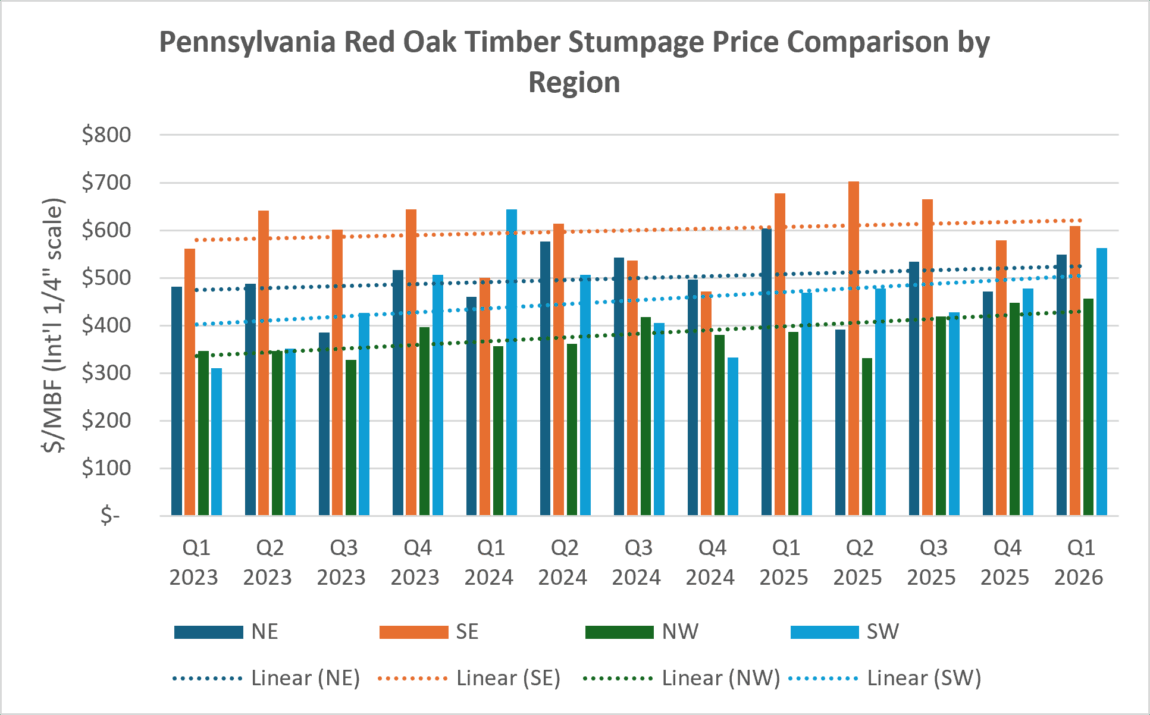
- Year-over-Year: Red oak prices saw mixed year-over-year results, with some regions reporting 18% to 20% increases and two reporting decreases of approximately -10%.
- Market Implications: Despite mixed year-over-year performance, red oak continues to realize a slight average increase in price.
White Oak
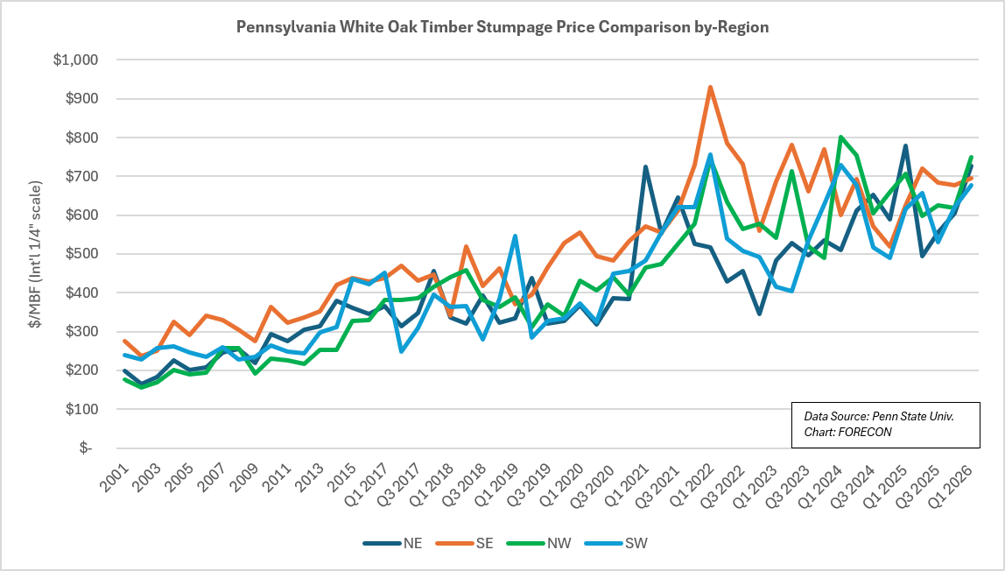
- Year-Over-Year: White oak stumpage prices remain elevated relative to long-term historical levels, with reported price increases in all but one area (Northeast). The chart illustrates a sustained upward trend over the past decade, punctuated by significant volatility beginning in 2021.
- Market Implications: White oak continues to be one of Pennsylvania's most valuable hardwood species, supported by demand from appearance-grade lumber, cabinetry, furniture, and export markets. While prices remain strong, the market appears to be transitioning from peak-cycle conditions toward a more balanced environment. Reports of increased stave-log inventories and softer expectations for bourbon barrel production may limit future price appreciation, although values remain well above pre-2020 averages.
Black Cherry
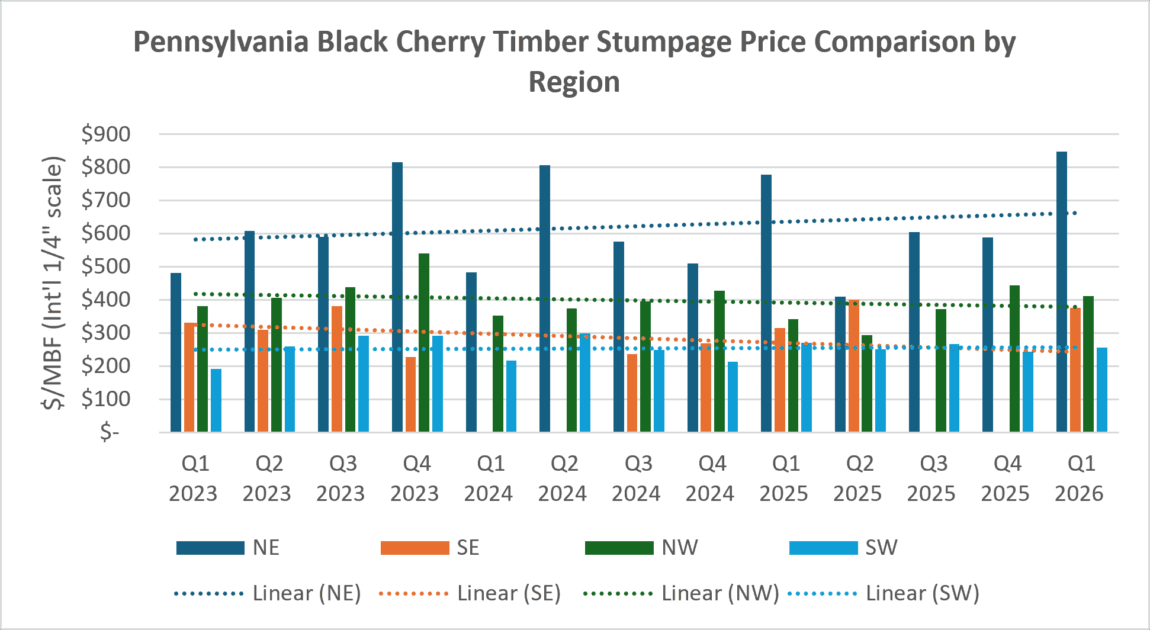
- Year-over-Year: All regions except the Southwest (-6%) reported year-over-year price increases, ranging from 9% to 20%.
- Market Implications: Pennsylvania remains the epicenter of black cherry production. The key distinction now is quality, with veneer and upper-grade logs performing well and lower grades remaining much more variable.
Hard Maple
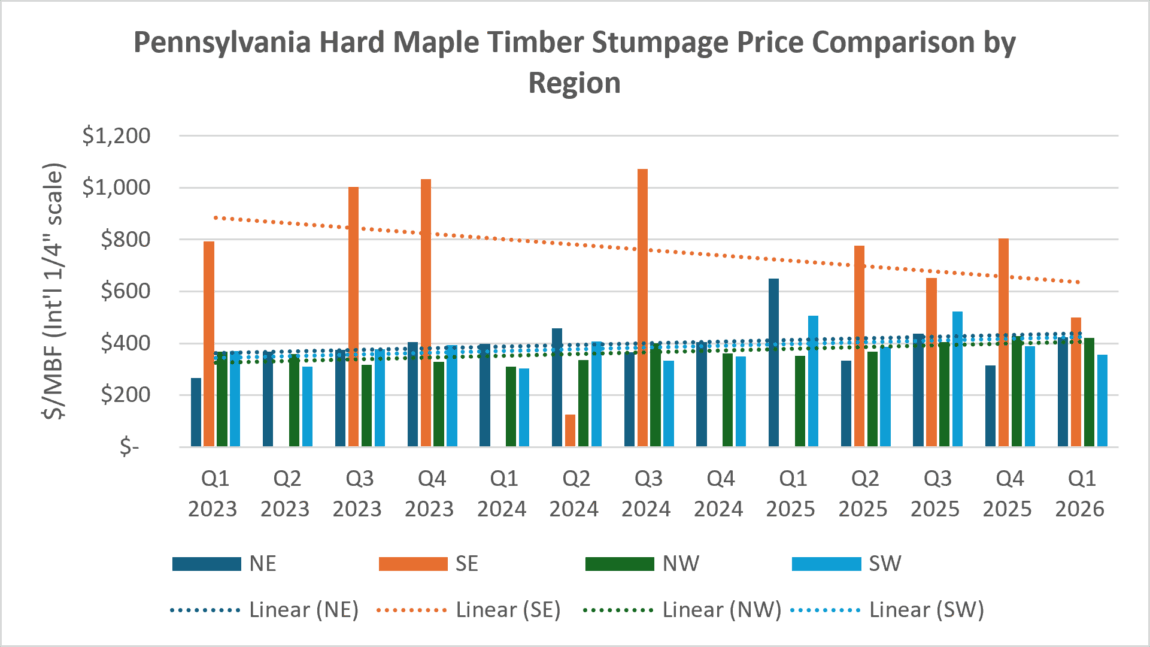
- Year-over-Year: Hard maple experienced significant year-over-year declines in the northeast and southwest (-35% and -30% respectively). The northwest experienced an increase.
- Market Implications: Hard maple continues to demonstrate price volatility, although most areas show slightly upward pricing trends. Higher grade timber is selling better than common due to the ability to utilize soft maple as an alternative.
Soft Maple
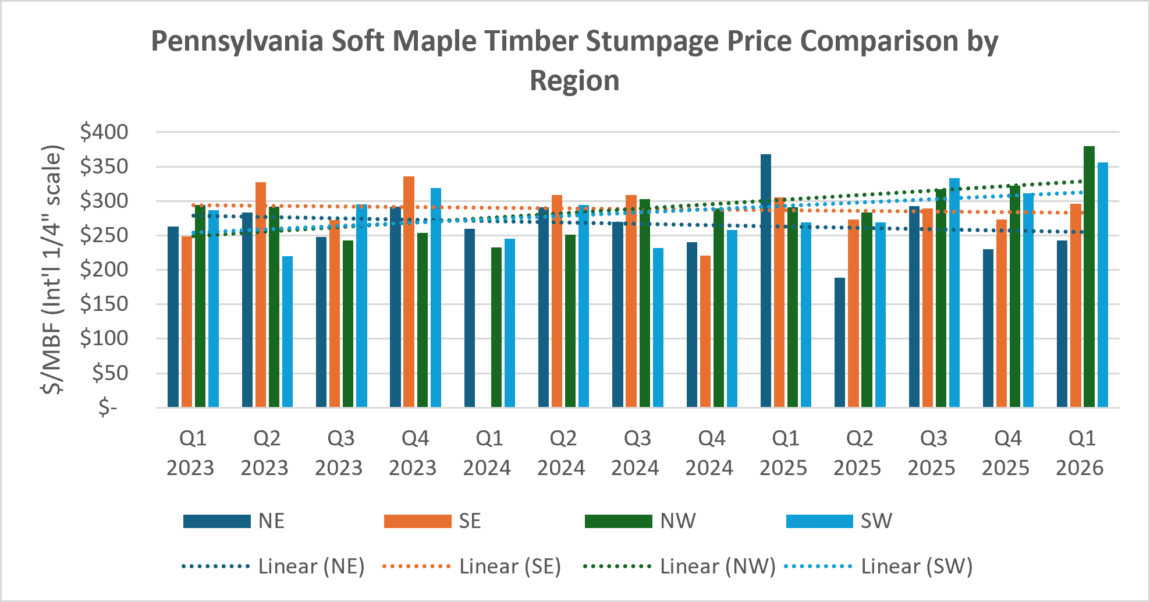
- Year-over-Year: The northwest and southwest reported increases of over 30%, while the northeast experienced a sharp decline of -34% and the southeast a small decline of -3%.
- Market Implications: Soft maple has remained surprisingly resilient, with prices generally tracking near hard maple in several regions. Recently, FORECON has begun to see signs of a decline for soft maple which will likely be reflected in the next quarterly update.
Yellow Poplar
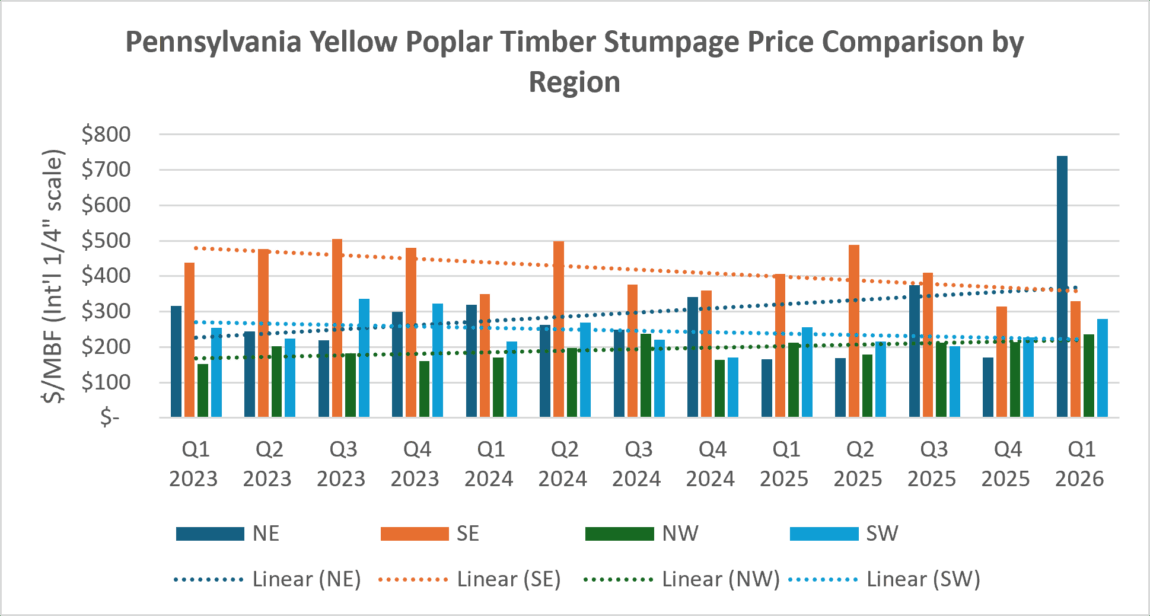
- Year-over-Year: All but one area saw price increases of approximately 10% (northwest and southwest) to 348% (northeast). It should be noted that the 348% increase is based on a sample size of 1, so it likely represents an outlier. The southeast experienced a decline of -19%.
- Market Implications: Yellow-poplar remains highly regionalized. The chart highlights the importance of local market conditions and sample size when interpreting statewide averages.
What Is My Timber Worth in Pennsylvania?
After reviewing statewide timber price trends, many Pennsylvania landowners naturally ask: What is the timber on my property actually worth?
While statewide stumpage reports provide valuable insight into market conditions, they should be viewed as benchmarks rather than exact indicators of value. No two woodlots are alike, and timber prices can vary substantially from one property to another.
Several factors influence the value of a timber sale, including:
- Tree species and product potential
- Timber quality, size, and grade
- Total harvest volume and stand density
- Access for logging equipment and trucking
- Terrain, operating conditions, and harvesting costs
- Proximity to sawmills and wood-consuming facilities
- Current local and regional market demand
Because these factors can significantly impact stumpage value, the most reliable way to determine what your timber is worth is through a professional timber appraisal or a competitively marketed timber sale. An experienced consulting forester can evaluate your timber resource, identify market opportunities, and help ensure you receive fair market value while meeting your long-term ownership objectives.
For landowners considering a harvest, professional guidance can often make a substantial difference in both financial returns and the long-term health of the forest.
Professional Forestry Assistance for Your Property

If you’re looking for local, responsive expertise, we encourage you to work with one of our seasoned foresters. Reach out to us here or call (716) 664-5602. Our firm has been helping landowners make informed forest management decisions since 1954.
Ask the Forestry Expert: Why Isn’t My Forest Growing Back?