When most timberland owners think about market risks, they typically focus on housing starts, interest rates, weather events, or local mill demand. A military conflict in the Strait of Hormuz, a narrow waterway between the Persian Gulf and the Gulf of Oman, may seem far removed from hardwood forests in Pennsylvania, New York, West Virginia, or New England. Yet global energy markets and regional timber markets are more connected than many realize.
For both private landowners and institutional timber investors, understanding these connections can help inform harvest timing, marketing decisions, and long-term investment strategy.
The Strait of Hormuz: A Critical Global Chokepoint
The Strait of Hormuz is one of the world's most important energy transportation corridors. According to the U.S. Energy Information Administration (EIA), approximately 20% of global petroleum liquids consumption passes through the Strait, making it one of the world's most strategically important maritime chokepoints. Any military disruption that restricts shipping can quickly increase oil prices and create uncertainty throughout global supply chains.
Historically, even the threat of conflict in the region has caused energy markets to react sharply. Higher energy prices ripple through transportation, manufacturing, construction, and consumer spending. These are all sectors that ultimately influence demand for hardwood products.
The Immediate Impact: Rising Transportation Costs
The most direct effect on northeastern hardwood markets is likely higher fuel costs.
Logging contractors, trucking companies, rail operators, and mills all rely heavily on diesel fuel. If crude oil prices rise significantly, harvesting and transportation costs increase throughout the supply chain.
For timberland owners, this can create several consequences:
- Logging contractors may become more selective about harvest opportunities.
- Hauling costs from remote tracts can increase substantially.
- Delivered log prices may not rise enough to offset higher operating costs.
- Marginal harvests may be postponed until market conditions improve.
Properties located closer to mills and major transportation corridors may gain a competitive advantage during periods of elevated fuel prices.
Hardwood Lumber Demand and the Broader Economy
Energy price shocks rarely stop at transportation costs. Sustained increases in oil prices can slow economic growth and reduce consumer spending. This matters because many northeastern hardwood products ultimately depend on discretionary consumer purchases, including residential furniture, cabinetry, flooring, millwork, and architectural products.
If households become more cautious due to rising energy costs and economic uncertainty, manufacturers may reduce production and lumber demand can soften.
For species such as red oak, hard maple, cherry, and ash, lower manufacturing activity can place downward pressure on lumber markets, which may eventually affect stumpage prices.
Export Markets: Potential Headwinds
The northeastern hardwood industry remains heavily connected to international markets. Exports account for a meaningful share of demand for both logs and lumber. According to the American Hardwood Export Council (AHEC) and USDA Foreign Agricultural Service trade data, international markets remain an important outlet for U.S. hardwood lumber production.
A conflict in the Strait of Hormuz can affect exports in several ways:
- Higher global shipping costs
- Increased marine insurance rates
- Longer transit times
- Greater currency volatility
- Slower economic growth in importing countries
Export-oriented mills may become more cautious with log procurement if overseas demand weakens or shipping costs become unpredictable. This risk is particularly relevant for higher-grade hardwood products that rely on international buyers in Europe, Asia, and the Middle East.
Why Investors Often Like Timberland During Periods of Uncertainty
Not all consequences are necessarily negative.
Historically, periods of inflation and geopolitical uncertainty have sometimes increased investor interest in real assets. For long-term timberland investors, a period of global instability may reinforce some of the attributes that make timberland attractive:
| Biological Growth: | Trees continue growing regardless of markets | |
| Timberland Attribute: | Benefit During Volatility | |
| Harvest Flexibility: | Sales can often be deferred | |
| Inflation Protection: | Timber values often adjust over time | |
| Tangible Asset: | Less correlated with financial markets | |
While short-term timber prices may experience pressure, the underlying investment characteristics of well-managed hardwood timberland generally remain intact.
What Should Timberland Owners Watch?
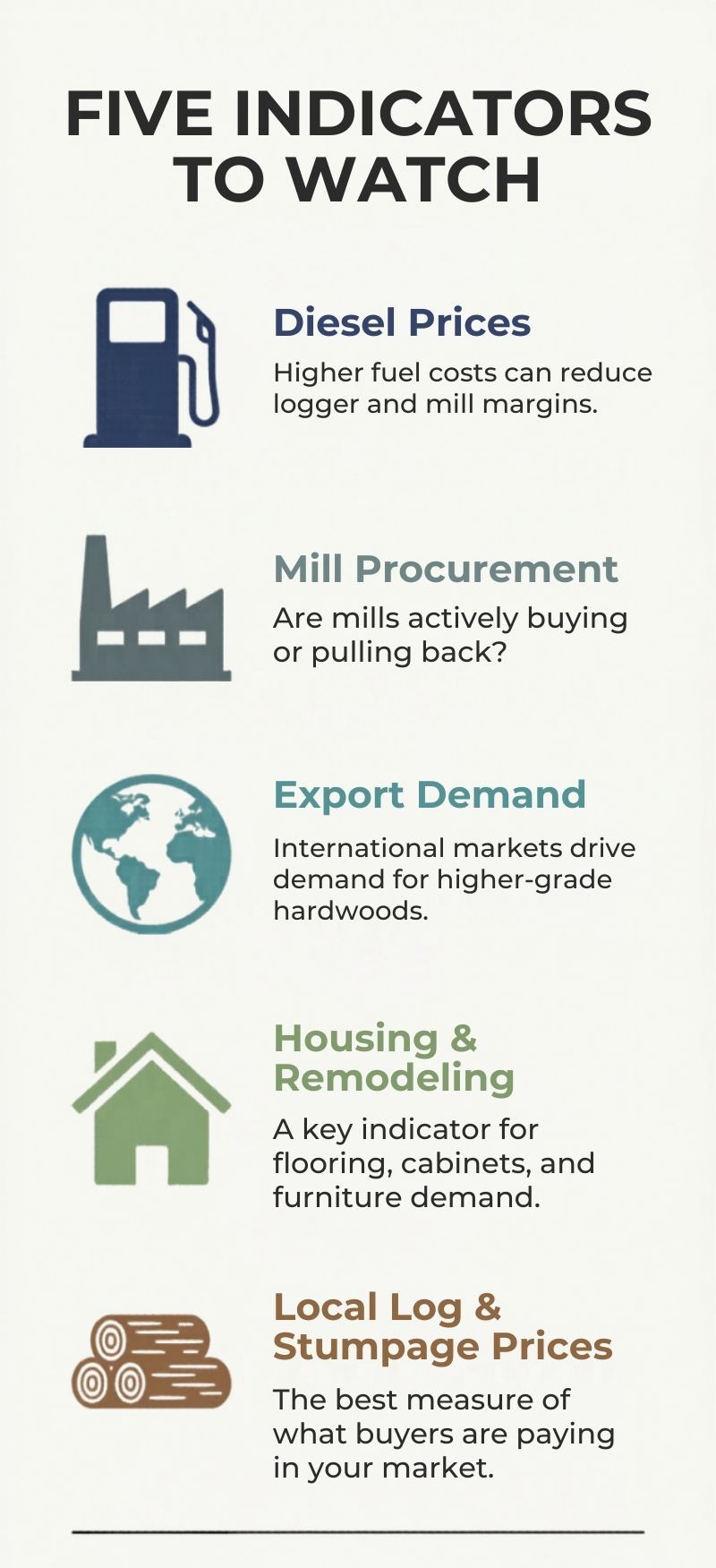
Rather than focusing solely on events in the Middle East, landowners should monitor several indicators that can provide insight into potential impacts on hardwood markets:
- Crude oil and diesel fuel prices
- Freight and trucking costs
- Housing and remodeling activity
- Hardwood lumber production levels
- Export demand indicators
- Mill procurement activity in local markets
The most important factor is not necessarily whether conflict occurs, but whether energy disruptions are severe enough to create sustained economic impacts.
A Long-Term Perspective
For northeastern hardwood owners, geopolitical events can influence markets, but they rarely alter the fundamental value of productive timberland. Well-stocked forests continue to grow, add volume, and improve quality over time.
Short-term disruptions may create temporary pricing volatility, but long-term timberland performance remains driven by biological growth, local mill infrastructure, forest productivity, and disciplined management.
The Strait of Hormuz may be thousands of miles from the hardwood forests of the Northeast, but its influence on energy markets serves as a reminder that today's timber markets are part of a deeply interconnected global economy. Understanding these linkages helps landowners and investors make more informed
Navigating Market Uncertainty?
Whether you're managing a 100-acre family woodlot or a multi-state timberland portfolio, understanding market conditions is critical to maximizing long-term value.
Contact FORECON to discuss how current market conditions may affect your timberland objectives and how a harvest, acquisition, or management plan can help you achieve your goals.

(716) 664-5602

Pennsylvania Timber Prices 2026: Hardwood Stumpage Market Update (Q1 2026)